Legacies of Michael Okpara Varsity Vice Chancellor Professor Iwe
Uduma
Legacies of Michael Okpara Varsity Vice Chancellor Professor Iwe
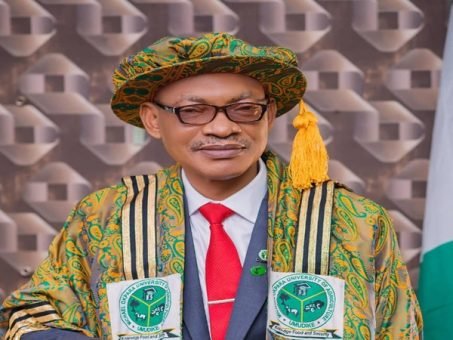
Professor Maduebibisi Ofo Iwe’s tenure as the sixth Vice-Chancellor of Michael Okpara University of Agriculture was a period of transformative leadership that restored stability, modernised operations, and positioned the university as a leading specialized institution in Nigeria. Assumed in March 2021 during a challenging post-pandemic period, his administration immediately confronted issues inherited from previous leadership, including strained staff relations, pending litigation, and a decline in institutional confidence. Despite these hurdles, Professor Iwe’s principled and visionary approach set the tone for a five-year era of progress and innovation.
One of his first priorities was to reconcile aggrieved staff and restore a harmonious working environment. Through dialogue and goodwill, he successfully resolved over 100 pending court cases and reestablished trust between staff and management. Beyond personnel matters, he also mended relationships with the university’s Microfinance Bank and revived MOUAU Nigeria Limited, previously dormant for over 15 years. These enterprises were restructured to generate revenue for the university, enabling infrastructural developments, including the expansion of the old guest house from 16 to 21 rooms and the construction of a new 51-room facility, which has been lauded as among the finest in Nigerian universities.
Professor Iwe also focused on industrial and agricultural projects that positioned the university as a hub of innovation. He operationalised the bread and biscuit factory and the water-treatment plant, ensuring that Umudike-branded products reached markets across Abia State. These ventures provided practical training for students in Food Sciences, Nutrition and Dietetics, Hospitality Management, Engineering, and other disciplines, bridging academic theory with industry experience. Complementing this, his administration promoted smart agriculture, producing farm-fresh vegetables and crops for both consumption and commercial sales, further strengthening MOUAU’s community engagement and revenue streams.
A strong emphasis on digitalisation marked another pillar of his leadership. The university’s Bursary, Library, and Medical Services were fully digitized, streamlining administrative processes, improving transparency, and enhancing accountability. The Senate now operates electronically, significantly reducing expenditures on paper and ink, while a biometric student capture system established a comprehensive database for improved record-keeping. These innovations facilitated quick access to student information, expedited the issuance of results and transcripts, and enabled students to access Federal Government loans such as NELFUND with greater ease.
Academic excellence was also a major focus of Professor Iwe’s tenure. Laboratories across all colleges, especially Science and Engineering programmes, were upgraded to international standards. The Centre for Molecular Biosciences and Biotechnology (CMBB) was expanded to support advanced research, and the TETFund Centre of Excellence for Root Crop Research and Development (CERCORD) was equipped with modern facilities. The administration also championed the Greenhouse Initiative, constructing a glass soilless greenhouse and enhancing research and production in smart agriculture. In addition, previously delisted programmes in the College of Management Sciences were restored, and new degree programmes such as Mechatronics Engineering, Food Engineering, and Embedded Artificial Intelligence were introduced to meet the demands of emerging industries.
Infrastructure and energy development under Professor Iwe were equally remarkable. The administration secured a Certificate of Occupancy and commenced work on a permanent campus at Olori, Oboro, with a N3 billion federal intervention fund. The university now operates under a two-campus structure, poised to rival first-generation universities. In addition, a 3-megawatt solar power plant was completed under the Energizing Education Project, providing uninterrupted electricity and significantly improving research, administration, and campus life.
International engagement also expanded significantly under his leadership. Professor Iwe led MOUAU into the League of Tropical Universities (LTU), serving as the African representative and linking the university to over 100 institutions across 40 countries. Multiple Memoranda of Understanding were signed, including with Hainan University, China, where staff now benefit from full scholarships up to the Ph.D. level in Food Engineering. These collaborations enhanced the university’s global reputation and provided opportunities for staff and students to engage in international research and exchange programmes.
Professor Iwe’s leadership earned widespread recognition and approval from staff, students, and stakeholders. A formal vote of confidence highlighted his credibility and effectiveness, acknowledging his principled, ethical, and inclusive approach. Despite occasional dissent from fringe elements and smear campaigns on social media, his commitment to transparency, accountability, and the university’s long-term vision remained unwavering. His tenure emphasized respect for institutional structures, harmonious engagement with the Senate and Governing Council, and the cultivation of a positive academic culture.
In conclusion, Professor Maduebibisi Ofo Iwe leaves behind a legacy of institutional transformation at Michael Okpara University of Agriculture. From restoring peace and operational efficiency to modernising laboratories, digitizing administrative systems, advancing smart agriculture, expanding infrastructure, and establishing international partnerships, his tenure has set a benchmark for future university leadership. The achievements of this era underscore the possibilities that visionary leadership can bring, leaving MOUAU better equipped to pursue excellence and limitless opportunities in the years ahead.